Least of These

Somerville High School Temporary Ramp, March, 2019

There’s a wonderful cartoon depicting an elementary school entrance after a big snowstorm. A group of winter-garbed children, a couple in wheelchairs, wait at the foot of  the school’s ramp as the custodian shovels the school’s stairs, right next to the ramp. “If you shoveled the ramp first we could all get inside,” a child says.

A couple of weeks ago I remembered that cartoon while attending a memorial for Chuck Woodbury (1920-2018), beloved member of my Quaker meeting. Attentive father and grandfather, noted psychologist, ardent violinist, Chuck was also so hard of hearing that in his last years attending our meeting for worship, needed someone to sit beside him to write down the vocal ministry shared that morning. So it was fitting that at his memorial, people who wished to share a story about Chuck would stand and wait until the hand mic would be delivered. (This mic usage a first, I think.)

Two things happened because of this. Like all those children able to get inside their school, everyone could hear. Like those folks my age who, for now, may be pre-hearing aid—but not for long. Or, as so often happens, when a speaker dropped their voice at the end of a sentence—we all do that—anyone could catch those last three or four words. And because the woman tasked with delivering the mic walks slowly, we all had ample opportunity to reflect on the previous message and on what Chuck’s full, graced life meant for us.

How would this world be if “What will work for everyone?” were our guiding principle?And isn’t asking this question without ceasing another way to be a peacemaker?


“She’s Everywhere!”

Sunset, Puerto Rico; March 14, 2019

Like crocuses, a conversation about the perils of perfectionism keeps popping up among my disparate friends these days. Which means that I, too, am looking at the Shoulds and the Oughts and the Am I Doing This Rights? in my own life. (and who, exactly, wrote this Should, Ought, Right Rule Book anyway?)

So noticed that among all the insidious ways I hold myself up to a standard that I should perhaps be rethinking, I was feeling inadequate/unworthy/doing it all wrong about how I was mourning my mother, who’d died in October of 2018. Shouldn’t I be actively missing her? Shouldn’t I be feeling enormous loss? Shouldn’t I—well, you get the idea, I’m afraid. And that, no, I wasn’t.

What has happened is that since she died I’ve taken on, incorporated my mother’s acuity, her ever-present sensibility about, as she called it, “the quality of light.” Which, I’m guessing, had been tied in to her seasonal affected disorder and began, as I recall, when she and my father moved to Cape Cod twenty-five years ago. (And may have been further inspired by this stunning, best-selling photography book.) I notice the light. I stop; I bask in it. I’m particularly moved by southern light. But moonlight will do. Saturday night I drank a glass of water lit by the almost-full moon shining into my kitchen. And when I did, I felt such gratitude for my mother’s hand-off to me.

But still . . . (Ought! Should! Wrong, wrong wrong!)

Flying home from Puerto Rico last week, I’d begun a book a friend had recommended, The Five Invitations: Discovering What Death Can Teach Us About Living Fully by Frank Ostasecki.What a perfect post-vacation book to read! When I was already examining my busy, anxious life and how, when I returned, I might avoid getting sucked up into all that craziness again.

And read this touching story the author shares about Samantha and Jeff—who was dying.

Jeff exhaled a few more times and didn’t breathe in again. A stillness and ease embraced us. I felt it as warmth and sensed a luminosity, a sort of brilliance. After sometime, Samantha spoke out loud, as if talking to the space more than to me. “I thought I was losing him, but he is everywhere.”

My mother is everywhere.


The View from Here


View From El Yunque National Forest; March 13, 2019

Travel is fatal to prejudice, bigotry, and narrow-mindedness, and many of our people need it sorely on these accounts. Broad, wholesome, charitable views of men and things cannot be acquired by vegetating in one little corner of the earth all one’s lifetime.” – Mark Twain

On our way to El Yunque National Forest, Narayan De Jesus Reyes, our excellent tour guide and driver, made a stab at this quote. Our small white bus weaving in and out of Puerto Rican traffic and over the island’s not-great roads, Narayan got Twain’s remarks pretty much right— although he was a little shaky on attribution. (Which happens a lot with Mark Twain quotes, right?)

So many ironies, so many paradoxes, so much to consider and to hold:

That so often, it is only the privileged who can afford to travel!

That, seemingly, travel = selfies these days, i.e. an opportunity, for example, to pose in front of a rainforest waterfall, post your ecstatic face on social media, then climb back onto a tour bus.

That there were so many tour buses! As we moved from site to site—most of the park’s trails are still inaccessible so we mostly stopped at look-out areas—Narayan constantly struggled to find a place to park. Every day, two or three humungous cruise ships visit San Juan; every day those cruise folks book tour buses bound for El Yunque.

These other tour buses proved a personal struggle. I resented all those fossil-fuel-powered vehicles—like the one I rode on; like the plane I flew on—and was grateful that this still-recovering-from Hurricane Maria paradise might benefit from all those tourists’ dollars. (That our mainland money might actually benefit Puerto Rico was a major reason why my husband and I had chosen to go there.)

That, according to Narayan, a good third of the rainforest’s trees had been destroyed by yet another climate-change-era superstorm. And, as one of the park’s rangers later told us, its famous, endangered parrots were seriously impacted by such devastation and now seem to have disappeared. The kicker?  I only know this because I can afford to take a guided tour to this holy place in a fossil-fuel-spewing bus!

About that holy place: For our last stop, Narayan had arranged for us to bathe in a delightful swimming hole surrounded by rich, tropical foliage and fed by a rainforest-generated river. Think of it!  As I sat on a volcanic rock at the bottom of a small, gurgling waterfall in bright sunshine listening to birdsong and the soft, gentle murmur of three young women nearby, I felt wholly blessed. Annointed. Utterly grateful. “My people believe El Yunque takes care of us,” Kenia, who served me breakfast the next day, explained. “That’s what you were feeling.”

Oh.


Small Thing/Great Love

Snow Squall Outside, Peace Cranes Inside

Yesterday was disquieting. Morning snow squalls were quickly followed by heavy winds, so strong the house shook and windows rattled. Some in greater Boston lost power, some lost chimneys; many trash cans and recycle bins ended up in neighbors’ yards or in the street. The light-rail service known as the Green Line was disrupted because of downed trees.

was disquieted, again disturbed by fears around not doing enough/should I do more/what is God asking me? And in this uneasy, soul-searching time, found myself, um, sorting earrings? Yup. I don’t want to brag but I even developed a new system for dealing with the remaining earring of a beloved but now one-missing pair. (I know, I know. Pretty impressive, huh.)

Let me elucidate: The little dish I throw my earrings and bracelets into at bedtime was full of all kinds of stuff and so, of course, in the midst of another spiritual crisis, I had to fix that. By dumping everything that had been in that little dish onto my bureau top. After dealing with the fore-mentioned singletons and putting earrings I seldom wear in my jewelry box and the loose change in my coin purse, the top of my bureau was pretty much bare. Except for a tiny, arrowhead-shaped piece of dark grey metal: a “widow’s mite.” (Or so it was touted on the piece of cardboard it was once attached to and, no, I have no idea how I got it.)

An answer! Right there on my bureau. About proportionality. (And Biblical scholars are free to argue about my take-away from this touching story from Luke.) Jesus points out that rich people contribute money generously because they can. But the poor widow’s puny offering of almost-worthless coins (to God) represents her “her livelihood.” Or, as I prefer to frame it, her modest contribution represents her enormous, generous, loving spirit.

Could I be doing more? Of course. Is what I am now doing “fixing” systemic racism or climate change or whatever else ails this broken world? Of course not. Is what I am doing done in a spirit of joy, generosity, love? Yes. Is it proportional; does it represent all I am asked to do?

Hmm. I’ll have to get back to you on that.


Room With A View

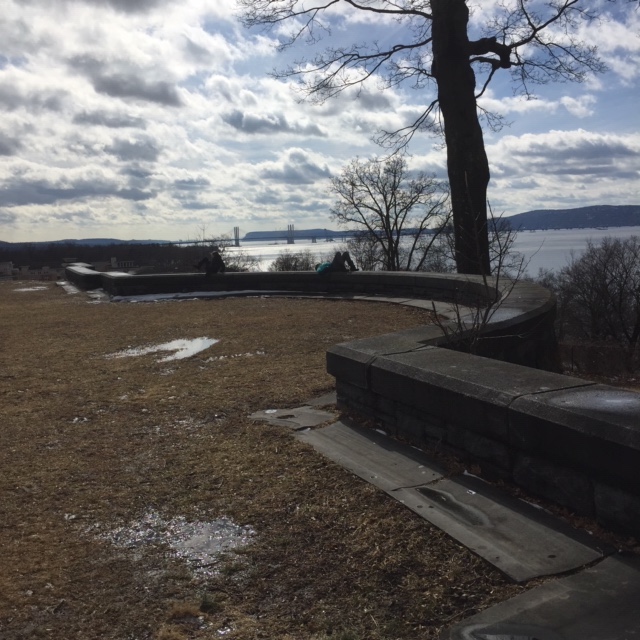
Rockwood Hall State Park, Sleepy Hollow, NY. (The Tappan Zee Bridge in the background.)

Thursday, a warm and sunny post-snowstorm day, while visiting my daughter and her family in Tarrytown, New York, I’d asked her if we could maybe take a walk along the Hudson. Her  eyes lit up: “Oh, yes,” she said, clearly excited to share yet another feature of her still-newish community (She and her family had moved to Tarrytown about a year and a half ago), “we can definitely arrange that.”

Ever since the UN report re climate change and how little time we have left, I am devouring books like The Overstory and Braiding Sweetgrass. My prayer life has expanded to include prayers, gratitude for all living things—especially trees. As much as I can, given winter weather and my urban surroundings, I’m walking through this precious, natural world as if both loving all I see and already mourning its loss. So I was psyched!

Land along the Hudson being prime real estate, I’d imagined our riverside walk would be maybe a mile or so long, on a wood-chip path through some overgrown vegetation, and end at some high-end development. So was astonished to find myself on the sculpted grounds of the Rockwood Hall State Park, perched above the Hudson, with magnificent views and wonderful, paved paths to explore but also, the beautifully designed landscape of a Frederick Law Olmsted-designed park. (It was my daughter’s father who’d first taught me how to recognize Olmsted’s eye-catching tree placement. On the campus of Vassar College. “See how your attention moves from this tree to that one and then to over there?” he’d coached. Yes. I did. Still do.)

But, wait! What’s the story behind all this magnificence? Who’d preserved these eighty-eight acres? Who’d made possible all this room with a view? Who’d hired Olmsted? The answer is: William Rockefeller. The brother of John D. Rockefeller and co-owner of Standard Oil Company. (I can still remember how brilliant I’d considered myself at eight or ten when I’d figured out that Esso, as in the name of the gas station—now known as Exxon, of course—was actually  S. O. As in Standard Oil.) He’d built Rockwood Hall; its foundations still stand although the mansion is gone. And, eventually, his vast estate—less than half of it anyway—became a state park.

Oh the irony. That our magnificent view, those perfectly-placed oaks and firs and sugar maples and sycamores, our excitement to watch soaring red-tailed hawks and a bald eagle, that glorious walk could have only happened because of the enormous wealth derived from a fossil fuel! A commodity which, like coal and natural gas, will make this planet unlivable for many, many species unless something truly miraculous happens.

Egad.


How It Ends

After listening to WellingUp.net’s podcasts, my daughter questioned an important, fundamental decision: “Why did you begin the story with Rocco’s death,” she wondered. “Wouldn’t it be better to tell the story chronologically?”

“No,” I answered. “I don’t think so.” And recalled a Dr. Martin Luther King, Jr. biography I’d read that begins with King’s assassination. “I felt like the book was way more powerful because I’d been reminded from the git-go that this wonderful man would be murdered, ” I told her. “And besides,” I continued. “This story is another version of the Jesus and Mary Magdalene story. And what do most people seem to remember about Jesus? How he died!”

I’ve been thinking about that conversation this past week as I read over my 2018 journals, a sobering, humbling end of the year/beginning of the year ritual I’ve performed for a few years, now. What? I did that stupid thing again? And again? And . . . Jeez! Every mention of my mother, who died in October of 2018, leaps off the page. Every conversation. Every health concern. Every interaction with a staff person at her long-term care facility. It’s all so precious.

So many excerpts I could share but here are few moments I’m so glad I recorded:

May 24, 2018 . . . Had a wonderful moment with Mom when she talked about dying and how it won’t be hard because she’s had such a wonderful life—and I told her how lovely it is that she told me that because her leaving will be less painful, knowing that. A sweet, lovely, who-would-have-predicted moment . . .

May 26, 2018 . . . Took Mom down to Black’s Nook where pond life is beginning to thrive. Water lilies, a frog, lots of birds—but no heron or geese—and Mom was pretty lively, herself. Reached over to touch a young man’s arm so she could look at his tattoo more easily. I teased her about touching strange men and she said,”If he’s brave enough to have tattoos he should be able to deal.” Or words to that effect . . . .

June 16, 2018 . . . Mom had lots to say about “A’s” [another resident she’d disliked] sudden death. Guilt, maybeWe talked a little about how, maybe A really was in a better place, not heaven, necessarily, but not in pain or angry or frustrated any more. A talk I again appreciated having with my mother. 

Oh, yes!

Tea For Two Or More?

May I be a boring old woman who talks about her health? 

Thank you.

Because what I’d like to say just might be helpful to you:

Like many people my age, my cholesterol’s not been great and, like many people my age, I’ve been told by both my primary care provider and my cardiologist I should go on statins. But I’ve resisted. Mostly because I’ve heard many things about statins’ nasty side effects—muscle cramps being the one I’d feared the most—and would prefer to not wonder, with every other ache or pain, “Is this the statins? Or something else?”

But a dear friend’s stroke this past summer forced me to look at my own mortality more honestly—so I succumbed. And started taking this new medication in late September. The day before the Kavanaugh hearing. And during that hearing, had a violent, horrific reaction!

Was this the statins? Or my body’s revulsion at what I was watching unfold in a United States Senate chamber? I guessed both —but mostly the meds. So stopped taking them.

Here’s where my story gets weird. Because at this same time I was also reading The Tea Girl of Hummingbird Lane, a novel about China, mothers and daughters, and puerh tea. Towards the end of the book, one character references Alice Waters (a household god around here); Waters states that by drinking puerh tea, she cut her cholesterol in half! Hello!

So I made a deal with my cardiologist. For two months I would drink a mug of this tea, a tea which quietly invites me to sit, to ponder, contemplate, savor with others, every day. And then I’d have my cholesterol tested. 

Dear reader: It’s working! In two months my cholesterol has lowered enough so that it is not longer flagged as a health concern. 

You’re welcome.

Muscle Memory

[Patsy Cline’s salt and pepper collection, Patsy Cline Museum, Nashville, Tennessee]

A wonderful surprise happened in 2018: I made two new, wonderful friends, both in their seventies, too. Over tea last week with one, a fellow peace activist and feminist, we discovered that although we’d grown up in very different parts of the country, our families’ respective religions differed, and she’d grown up with more siblings than I, in one respect, her parents and mine were exactly the same. She and I, who’d both grown up in the fifties and early sixties, had both taken piano lessons. And ballroom dancing!

We snickered. And agreed that learning how to waltz or foxtrot was not something young people ascribed to anymore. She quoted that famous line: “Ginger Rogers did everything Fred Astaire did—only backwards and in high heels.” And I shared a story from my thirties, when my then-husband and I—probably chemically enhanced, shall we say?—had crashed a big, fancy, neighborhood party one summer night, a party held in a tent and with a live band. Boldly I’d invited a neighbor I really, really admired to dance with me. Kind of shy, not a dancer, he’d hesitated: “Don’t worry, darlin’,” I’d assured him. “I’ll make you look good.” And I did. Because from my ballroom-dance classes, I knew how to balance my weight on the balls of my feet; how to lightly rest my left hand on my partner’s shoulder in order to sense whatever direction he would go, and in a split-second, feet poised to respond, to accommodate that movement—wherever!

What a dated, horrifying story! But it begs me to wonder: Do I still do that? Do I still, in ways I don’t even realize because it’s just what I was trained to do, do I still wait, poised to move in response to someone else? Do I accommodate? Dedicate myself to making someone else look good?

Hmmm.


One Small Thing

El Salvadoran mural featuring Monsenor Oscar Romero by Allison McKeller, December 7, 2007

I am delighted to report that the Friends Journal will publish my “Sweet Baby Jesus” on December 1st!

And that of the four choices I’d offered for the article’s accompanying illustration, they chose this mural! My favorite. Yes, it depicts sweet baby Jesus. (I love that his swaddling clothes are green. As in verdant, growing, life-giving.) And offers a visual tribute to liberation theology, referenced in my piece.

But to look at this mural, the same week asylum-seekers were tear-gassed at our border, is to be again reminded of Oscar Romero’s murder. We remember the upheavals and horrors of Central America—and our country’s role in those upheavals and horrors. We remember why people seek asylum. We remember.


My Public Charge Letter (First Draft)

[Information re Public Charge]

To: Samantha Deshommes, Office of Policy and Strategy, U.S. Citizenship and Immigration Services, Department of Homeland Security, 20 Massachusetts Avenue NW, Washington, D C 20529-29140

[Link to submit comments online]

Re: DHS Docket No. USCIS-2010-0012

I am writing to express my opposition to this proposed rule change.

[Okay, fine. That’s the standard stuff. But what should I say? “Write from your place of strength,” an immigration advocate coached a group of us letter-writers recently.

What’s mine? Do I note that because of the fear these proposed changes are causing, providers of greater-Boston health care services note a 5 to 10% drop in people coming to their clinics? So, for example, people aren’t getting flu shots? And how that makes me very nervous to get on public transportation or shop at my neighborhood supermarket? Or how I am fearful how these changes, designed to instill fear and insecurity,  will adversely effect the wonderful, upbeat people, most of them from other countries, who work at my mother’s long-term care facility?

Absolutely not! Public Charge isn’t about white, privileged me or my white, privileged family! It’s about the Trump Administration rewriting Emma Lazarus‘s poem to read, “We only want you if you’re young, healthy, wealthy, and speak English.”

No, my place of strength is the same place as so many of those who these proposed changes would exclude: I am a grandmother. I know how my family needs me. I know how my family relies on me. I know how the stories I tell my grandchildren, my “These are some of the men and women who came before you; here’s what they thought was important” narratives anchor my family. I know how grandparents’ (free) childcare makes it possible for both parents to work. Grandparents cast a long shadow in ways I can speak to. Grandparents make this country work in ways few understand or acknowledge.

But I better get to work. These letters, which can be as short as 250 words, are due by December 10, 2018.]

Can We Hold All Of It?

Fort Rosecrans National Cemetery, San Diego, CA; November, 2015

Can we hold all of it? Can we both honor the war dead and wonder why, dear God, are we still engaged in endless war? Can we both use words like sacrifice and courage and service with conviction and sincerity and compassion while asking ourselves, are there other words I could be saying, too? Illuminating words? Game-changing words? Words that come from a deep and wise and loving place? Can we both grieve and resent that we are?

I’m trying to. And have come to realize that since the death of my mother a month ago, I’ve been practicing this spiritual balancing act. Because, yes, I mourn, yes, I miss her every day, yes, I’m sad, yes, I am grateful for all she imparted; how she’d modeled so many ways to be a strong, fulfilled woman. (Just writing fulfilled, a word she used all the time, makes me smile.) And yes, my relationship with Pat Wild was—and is— the most rich and complicated and challenging relationship I will ever have! So, yes, I am learning to hold all of it. Slowly. And sometimes failing, falling.

Meanwhile: The world just noted the one-hundredth anniversary of the end of “The Great War.” (aka “The War To End All Wars.”) Meanwhile: Veterans for Peace just reclaimed Armistice Day. Meanwhile, my mother’s unambiguous, clear, firm, posthumous message to me: be grateful.